


.svg)
.svg)
.svg)


.svg)
.svg)


.svg)

.svg)
.svg)


.svg)


.svg)


Indicators of Exposure (IoE): Definition and Examples

What’s on this page
What are Indicators of Exposure (IoE)?
Indicators of Exposure (IoEs) are externally observable security Issues that could make an organization easier to discover, target, or exploit. Examples include unknown internet-facing assets, exposed administrative interfaces, vulnerable technologies, cloud misconfigurations, and risks introduced by third parties.
Cybersecurity teams have traditionally relied on threat intelligence to track threat actors, understand malicious activity, and respond to Indicators of Compromise (IoCs). However, before an attack begins, threat actors often spend considerable time in the reconnaissance stage, quietly mapping an organization’s external environment. They search for exposed assets, vulnerable technologies, forgotten systems, leaked credentials, third-party associations, and other potential entry points.
While attackers actively observe what is visible from the outside, many security teams still focus on detecting malicious activity after a campaign has already started. This creates a critical gap between what attackers can see and what defenders are monitoring.
Therefore, today’s organizations need visibility earlier in the attack lifecycle. These early signals are Indicators of Exposure (IoE).
Indicators of Exposure (IoE) Explained
IoEs represent the signs that your organization has “open doors” or issues visible from the public domain. By proactively identifying and fixing these exposures, security teams can eliminate potential entry points and strengthen the organization’s overall security posture.
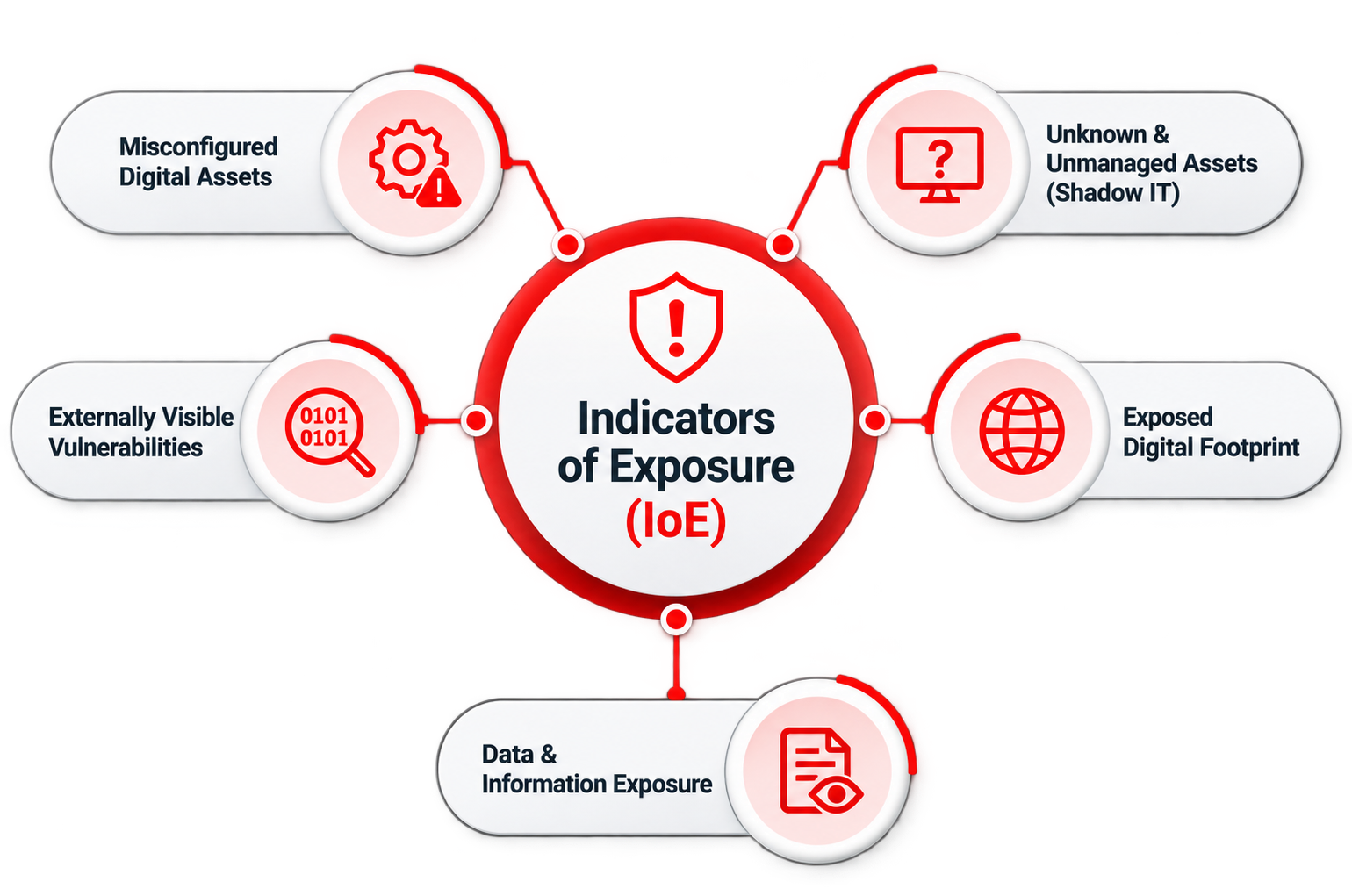
Examples of Indicators of Exposure(IoEs) include:
Misconfigured Digital Assets
Small configuration mistakes can create significant security risks.
Examples include:
- Incorrect DNS configurations
- Exposed administrative interfaces
- Publicly accessible storage
- Forgotten internet-facing systems
These exposures can reveal valuable information about an organization’s infrastructure and create potential entry points for attackers.
Unknown and Shadow IT Assets
Organizations often have digital assets that security teams are unaware of, including:
- Legacy systems
- Forgotten domains
- External applications
- Cloud resources
- Third-party hosted services
- Expired certificates and licenses
Without visibility into the complete external attack surface, organizations cannot effectively protect assets that remain undiscovered or outside their awareness.
Shadow AI Exposure
Shadow AI exposure includes the potential disclosure of sensitive company information through the unauthorized or unintended use of public AI tools.
Externally Visible Vulnerabilities
Internet-facing technologies are continuously evolving, and new vulnerabilities are discovered regularly. Indicators of Exposure (IoE) help identify externally visible systems running vulnerable technologies, misconfigurations, and other security issues, enabling faster prioritization and remediation before they can be exploited
Third Party Related Exposure
Third-party platforms and external sources can also expose information related to your organization, expanding the overall attack surface.
- Vendor & Partner
- Recruitment Sites
- Articles / Blogs / Forums
- App Store Listings
Why Indicators of Exposure Are Important in Today’s Cybersecurity Landscape
Organizations operating in today’s digital environment no longer function within a clearly defined perimeter. They increasingly rely on:
- Cloud infrastructure
- SaaS applications
- Remote access services
- Third-party vendors
- Digital technologies
- Mobile applications
- Social media channels
- Public-facing websites
Every connected asset expands the organization's external attack surface.
As digital environments continue to expand, security teams face a visibility challenge: they cannot protect what they cannot see.
Indicators of Exposure provide the missing visibility by helping organizations understand:
- What assets are publicly exposed?
- Which security issues are visible to attackers?
- Where security gaps exist
- Which exposures require immediate action
The Role of IoE in Next-Generation Cyber Threat Intelligence
As the volume of digital assets and cyber threats continues to grow, traditional IoC-based cyber threat intelligence (CTI) is no longer enough.
The NIST definition of an IoC is broader than “evidence left after an attack.” It includes technical artifacts that may indicate an imminent or ongoing attack as well as a compromise that has already occurred.
Therefore, organizations need intelligence that provides visibility into:
Indicators of Exposure (IoE)
Understanding what is publicly exposed and where security weaknesses exist.
Indicators of Warning (IoW)
Identifying early signals that someone is preparing malicious infrastructure and planning an attack.
Indicators of Attack (IoA)
Understanding active threats and attack campaigns directed toward an organization. Indicators of Exposure support a more preemptive approach to security by helping organizations identify and address weaknesses before attackers can exploit them.
Together, these Indicators of Exposure, Warning, and Attack form the foundation of Next-Gen Cyber Threat Intelligence (CTI). Next-Gen CTI identifies your IoE, IoW, and IoA across your unified Digital Asset Register.
How Artificial Intelligence (AI) Enriches Indicators of Exposure
The scale of modern digital environments makes manual monitoring increasingly difficult.
Organizations may have thousands of external assets, constantly changing technologies, and large volumes of threat information to analyze.
Artificial Intelligence (AI) helps enhance exposure intelligence by:
- Processing large volumes of external data
- Connecting relationships between assets and threats
- Identifying emerging patterns
- Prioritizing the most relevant risks
By combining AI with continuous external visibility, organizations can better understand their exposure across the digital landscape and focus security efforts where they matter most.
Key Takeaways
Indicators of Exposure (IoE) enable organizations to take a preemptive approach to cybersecurity by identifying weaknesses before attackers can exploit them. By continuously monitoring exposed assets, vulnerabilities, misconfigurations, and exposed information, security teams can reduce attack opportunities and strengthen their overall security posture. IoE provides the early visibility required to stay ahead of evolving cyber threats.
When IoEs are combined with Indicators of Warning, Indicators of Attack, and IoCs, organizations gain a more complete view of cyber risk, from exposure and threat preparation to active attack and possible compromise.
Discover CTM360 helps organizations identify exposed assets, vulnerabilities, digital risks, and emerging threats through continuous external monitoring.
FAQs
Are Indicators of Exposure only related to technical vulnerabilities?
No. IoEs include more than software vulnerabilities. They cover a broad range of external risks, unknown assets, cloud misconfigurations, and other weaknesses visible from outside the organization.
How do Indicators of Exposure support proactive cybersecurity?
IoE enables organizations to identify and fix security gaps before attackers exploit them. By addressing exposure early, security teams can reduce attack opportunities and improve their security posture.
What is the relationship between IoE, IoW, and IoA?
IoE, IoW, and IoA represent different stages of cyber risk visibility:
- Indicators of Exposure (IoE): What is exposed and could be exploited.
- Indicators of Warning (IoW): Early signals that a threat may develop.
- Indicators of Attack (IoA): Active threats targeting your organization.
Together, they provide a complete view of risk from exposure to active attack.
.png)
