


.svg)
.svg)
.svg)


.svg)
.svg)


.svg)

.svg)
.svg)


.svg)


.svg)


What Is CTEM? Continuous Threat Exposure Management Explained

What’s on this page
Continuous Threat Exposure Management, or CTEM, is a framework developed by Gartner to help organizations identify and reduce the security exposures that matter most to the business.
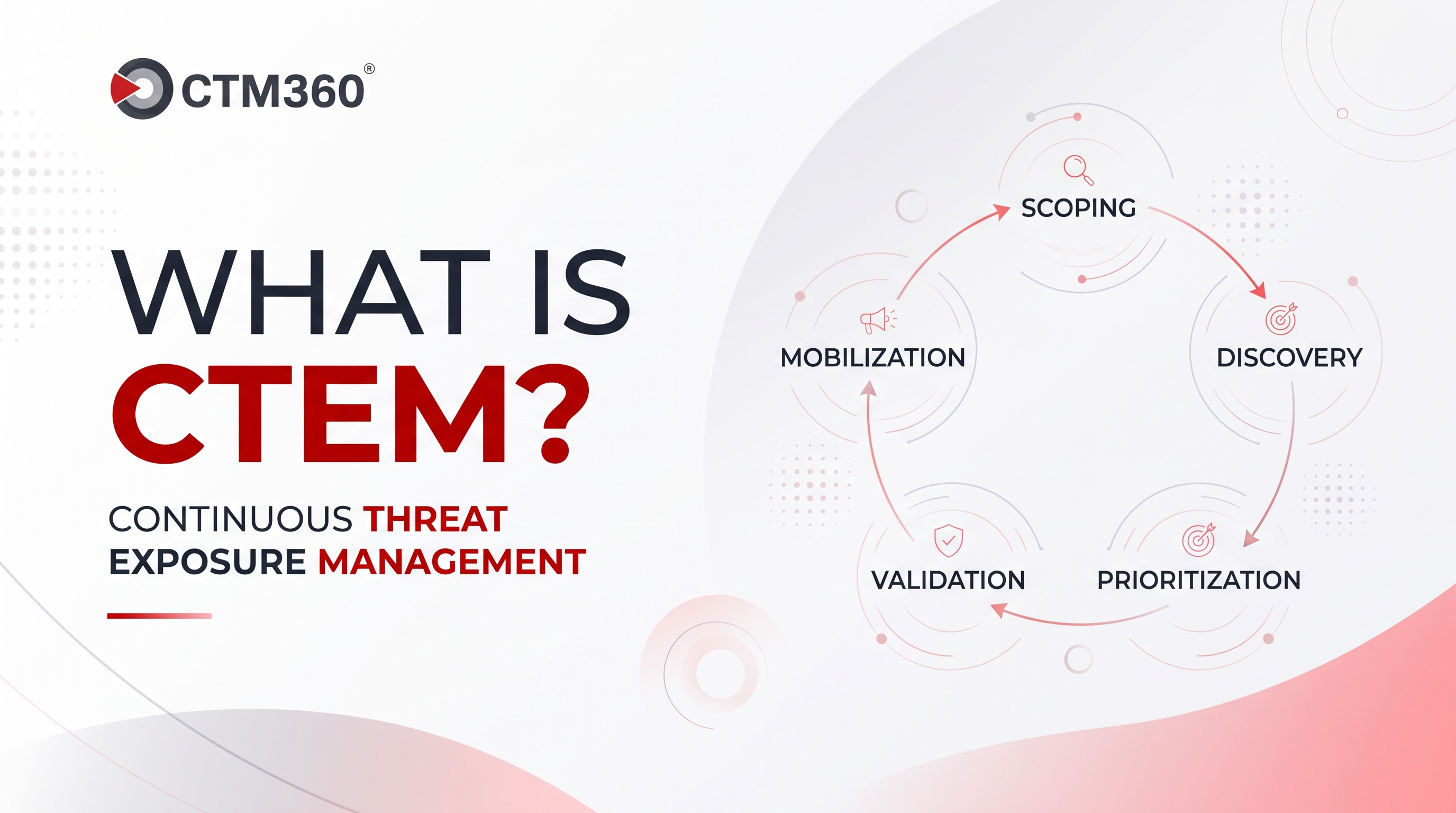
It follows five stages: scoping, discovery, prioritization, validation, and mobilization. Together, these stages help security teams move beyond finding vulnerabilities and focus on whether an exposure presents a credible risk, who owns it, and what needs to happen next.
CTEM is not a product. It is a repeatable way of organizing exposure management across security teams, asset owners, processes, and supporting technologies.
Why Is CTEM Important?
An organization’s digital presence extends across internet-facing infrastructure, cloud services, applications, identities, third-party environments, and customer-facing channels. As these environments change, security exposures also change.
Threat actors may discover a forgotten application, exposed service, compromised credential, or misconfiguration before the organization recognizes the risk. Meanwhile, security teams often face more findings than they can realistically investigate or remediate.
CTEM addresses this challenge by helping organizations determine:
- What assets and business services matter most
- Which exposures exist within the defined scope
- Which exposures present credible business risk
- Whether existing controls reduce that risk
- Who is responsible for remediation or mitigation
- Whether the action taken has reduced the exposure
CTEM turns these activities into a repeatable cycle. Gartner describes it as a process-oriented framework for proactively identifying where an organization has risk. It connects technical findings with business context and coordinated action rather than treating every vulnerability as equally urgent. (Gartner)
What Are the Five Stages of CTEM?
The five stages of CTEM form a continuous cycle. Findings, validation results, and remediation outcomes from one cycle help refine the scope and priorities of the next.
1. Scoping
Scoping defines the business services, assets, identities, technologies, and relationships that the CTEM program should assess.
The scope should reflect business priorities rather than attempting to assess the entire organization with equal depth. It may begin with a critical customer service, an external attack surface, a cloud environment, or another area where disruption would create significant business impact.
Effective scoping establishes:
- The business services being protected
- The assets and dependencies supporting those services
- The owners responsible for them
- The types of exposure to be assessed
- The intended risk-reduction outcome
The scope can expand as the CTEM program matures.
2. Discovery
Discovery identifies assets, weaknesses, and other exposures within the defined scope.
These may include:
- Known and unknown digital assets
- Software vulnerabilities
- Security misconfigurations
- Exposed services
- Identity and access weaknesses
- Cloud configuration issues
- Security control gaps
- Third-party exposures
Discovery must keep pace with changes in the environment. A static inventory or periodic scan may miss assets and exposures that appear between assessments.
3. Prioritization
Prioritization determines which exposures require attention first.
A CTEM program should consider more than a finding’s technical severity. Relevant factors may include:
- Business impact
- Asset criticality
- External accessibility
- Exploitability
- Active threat activity
- Existing security controls
- Potential attack paths
- Remediation effort and operational constraints
This context helps teams focus limited resources on exposures most likely to create material risk.
4. Validation
Validation determines whether an exposure presents a credible attack path and whether existing controls can prevent or detect its use.
Depending on the exposure and the organization’s authorization boundaries, validation may involve:
- Technology-specific security checks
- Configuration reviews
- Attack path analysis
- Breach and attack simulation
- Penetration testing
- Control testing
- Evidence-based technical review
Validation can confirm that a high-priority finding presents genuine risk. It can also show that a seemingly critical finding is mitigated by existing controls.
Validation activities should always be authorized, appropriately scoped, and proportionate to the potential operational risk.
5. Mobilization
Mobilization converts validated findings into coordinated action.
Security teams work with asset owners, IT operations, cloud teams, application teams, and other stakeholders to:
- Agree on the appropriate risk treatment
- Assign accountable owners
- Establish remediation priorities and timelines
- Track actions through completion
- Verify that the exposure has been reduced
- Escalate accepted or unresolved risk when necessary
Mobilization is more than creating a remediation ticket. Its purpose is to ensure that the organization can act on exposure intelligence and demonstrate a measurable outcome.
CTEM vs Vulnerability Management
Vulnerability management remains an important part of CTEM, but the two are not interchangeable.
CTEM expands the scope beyond vulnerabilities that can be resolved through patching. It can include misconfigurations, identity weaknesses, exposed services, unknown assets, third-party risks, and gaps in security controls.
Gartner’s guidance positions CTEM as a way to move from a vulnerability-centric approach toward a broader and more dynamic exposure management program. (Gartner)
External CTEM Begins With Visibility
CTEM can address internal and external attack surfaces. For the external scope, security teams first need a current view of the organization’s internet-facing digital presence.
At CTM360, this visibility is organized through a Digital Asset Register: a continuously managed inventory of external digital assets and their business relationships. Depending on the organization, this may include:
- Domains and subdomains
- IP addresses and hosts
- Internet-facing services
- Cloud-hosted resources
- Mobile applications
- Social media accounts
- Subsidiaries and related organizations
- Other externally observable digital entities
Asset ownership and business context give this inventory operational value. They help teams establish the assessment scope, identify relevant exposures, and determine which findings require action.
Threat intelligence adds another layer of context by showing how exposed assets, malicious infrastructure, and threat activity may relate to the organization.
An Example of External CTEM
Consider an organization whose CTEM scope includes customer-facing services.
During discovery, the security team identifies an overlooked customer portal running outdated technology. The team assesses the portal’s accessibility, business purpose, technical weakness, and relevant threat activity to determine its priority.
An authorized, technology-specific check validates whether the weakness affects that particular system. The finding is then assigned to the responsible owner, remediated or mitigated, and reassessed to confirm that the exposure has been reduced.
Continued monitoring detects later changes to the portal or its supporting infrastructure and feeds those findings into the next CTEM cycle.
This example shows why CTEM is more than vulnerability discovery. It connects asset context, prioritization, validation, ownership, remediation, and verification.
How CTM360 Supports the External Scope of CTEM
CTM360’s Next-Gen Cyber Threat Intelligence stack connects external asset visibility with exposure assessment, threat intelligence, and response.
Its organization-specific indicators provide context across the external threat lifecycle:
- Indicators of Exposure (IoEs) identify externally observable weaknesses, such as vulnerable technologies, exposed services, or misconfigurations.
- Indicators of Warning (IoWs) identify signs that a potential threat may be developing, such as newly registered lookalike domains or suspicious infrastructure.
- Indicators of Attack (IoAs) identify active targeting, including phishing campaigns, malicious impersonation, and fraudulent infrastructure.
IoE, IoW, and IoA are CTM360 intelligence categories. They are not additional Gartner CTEM stages. Instead, they provide external context that can inform discovery, prioritization, validation, and response across a CTEM program.
CTM360 capabilities support the external CTEM cycle in several ways:
- Digital Asset Register and HackerView: Support the discovery and monitoring of external digital assets.
- Exposure assessment: Identifies visible vulnerabilities, misconfigurations, exposed services, and other security issues.
- DeepScan: Performs technology-specific, active but non-intrusive checks to help validate known vulnerabilities and other exposures. (CTM360 DeepScan)
- CyberBlindspot: Monitors external digital threats affecting the organization, its customers, brands, and executives.
- Managed response: Supports the investigation, takedown, and disruption of confirmed malicious infrastructure.
These capabilities can help organizations operationalize the external portion of a CTEM program. Internal environments, identities, controls, and remediation workflows may require additional technologies and organizational processes.
Key Takeaways
Continuous Threat Exposure Management is a five-stage framework for reducing the security exposures most relevant to the business.
Its value comes from connecting five activities that are often managed separately:
- Define what matters.
- Discover relevant assets and exposures.
- Prioritize using technical, threat, and business context.
- Validate whether the risk is credible.
- Mobilize the organization to reduce and verify that risk.
CTEM does not replace vulnerability management or an organization’s existing security tools. It provides the operating framework that connects them to business-aligned exposure reduction.
For organizations applying CTEM to their external environment, current asset visibility is the foundation. CTM360 connects this visibility with exposure assessment, external threat intelligence, validation, and managed response.
Discover the CTM360 Cyber Threat Intelligence Stack
Frequently Asked Questions
What does CTEM stand for?
CTEM stands for Continuous Threat Exposure Management. It is a five-stage framework for continuously scoping, discovering, prioritizing, validating, and reducing security exposures.
Is CTEM a framework or a product?
CTEM is a framework, not a product. Organizations implement it as an ongoing program supported by the people, processes, and technologies appropriate to their environment.
What are the five stages of CTEM?
The five stages are scoping, discovery, prioritization, validation, and mobilization. They operate as a repeating cycle rather than a one-time assessment.
Does CTEM replace vulnerability management?
No. Vulnerability management is an important input to CTEM. CTEM extends the process to additional exposure types and adds business-aligned scoping, contextual prioritization, validation, and coordinated remediation.
Does “continuous” mean constant security scanning?
Not necessarily. Continuous refers to the recurring and adaptive nature of the CTEM program. The frequency of discovery, validation, and reassessment should reflect the rate of change, business importance, and risk of the environment being assessed.
How do IoE, IoW, and IoA relate to CTEM?
In CTM360’s approach, Indicators of Exposure, Warning, and Attack describe different forms of organization-specific external intelligence. They can inform decisions across a CTEM program but are separate from Gartner’s five-stage framework.
.png)

