.svg)
.svg)
.svg)


.svg)
.svg)


.svg)

.svg)
.svg)


.svg)


.svg)


Phishing & Fake Ads


%201.svg)
Relevant Teams
%201.svg)
%201.svg)


Addressed Through CyberBlindspot
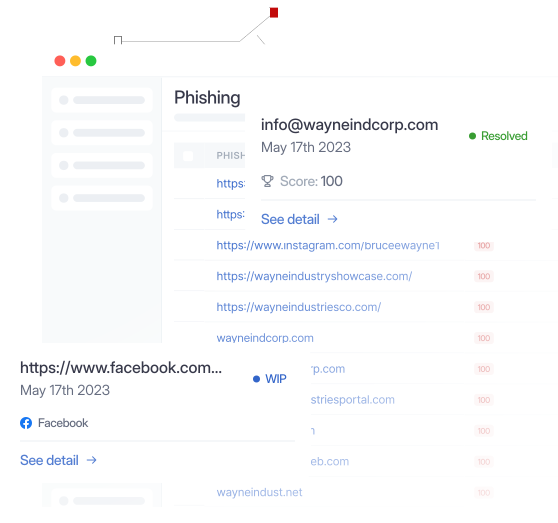
Protect your Customers and Brand from Phishing Attacks and Fraudulent Ad Campaigns
With advanced detection and takedown capabilities, CTM360 disrupts phishing and fake ad campaigns across major platforms and removes the associated malicious infrastructure.
How CyberBlindspot Detects and Disrupts Phishing and Fake Ads
Phishing Campaigns
Phishing campaigns spread widely via email, fake ads, SMS, messaging platforms, and malicious links impersonating trusted brands. CTM360 leverages AI agents to automatically analyze these phishing infrastructures and extract proactive intelligence to timely disrupts these campaigns across multiple channels.
Evasive Phishing Sites Detection Technologies
CTM360 deploys continuous detection methodologies for evasive phishing websites that may be geo- or user-agent-restricted. Using methods such as bypassing IP filtering, georestrictions, dynamic rendering techniques, and similar, Hidden threat infrastructure is uncovered and taken down with precision and consistency.
Evil Twin Sites
Evil Twin websites are sophisticated phishing sites designed to closely replicate legitimate brands, portals, and online services to steal credentials. CTM360 detects these sites through domain monitoring. Verified cases are escalated to hosting providers and registrars for takedown to help protect user data.
Executive-Targeted Phishing
Threat actors increasingly target senior executives through highly tailored phishing campaigns and impersonation attacks. These attacks often aim to facilitate Business Email Compromise (BEC), financial fraud, account compromise, or unauthorized disclosure of information. CTM360 continuously monitors for such targeted campaigns and disrupts them.
Fake Ads & Malvertising
Fraudulent advertisements frequently impersonate brands, products, services, and executives. These campaigns often redirect users to phishing websites, credential-harvesting portals, fraudulent investment schemes, or other malicious content. CTM360 monitors digital ad networks and flags such attempts for swift removal.
Email & Communication Fraud
Fraudulent communications such as Business Email Compromise (BEC), spoofed emails, and targeted phishing messages are designed to deceive employees, executives, and customers. CTM360 fast-tracks takedowns of such malicious communications to safeguard organizational trust.
Persistent Domain and URL Surveillance
CTM360 continuously monitors and reassesses domains and URLs across the digital ecosystem. The threat infrastructure that initially appears benign is tracked over time to identify weaponization patterns. This persistent visibility enables early disruption before attack campaigns scale.
Frequently Asked Questions
What types of phishing does CTM360 detect?
CTM360 detects phishing campaigns across email, SMS, fake ads, instant messaging platforms, social media platforms, and malicious URLs. Coverage includes mass phishing, Business Email Compromise (BEC), executive-targeted attacks, fake ads, and credential harvesting scams. Once validated, CTM360’s Cyber Incident Response Team (CIRT) escalates these threats for swift takedown.
How does CTM360 protect against credential-harvest sites?
Fake login sites are detected through page-similarity analysis, logo recognition, and infrastructure monitoring, and then disrupted and taken down.
How quickly are phishing sites neutralized?
Threats can be disrupted, often within minutes, through CTM360’s escalation channels, with CTM360 CIRT leveraging its global connectivity and integrations.
What actions are taken after Fake Ads detection?
Fake Ads are taken down to limit uptime and protect users from potential financial loss.