The Part of Cyber Risk That Never Touches Your Network


What’s on this page
A customer loses money through an investment advertisement featuring the chief executive’s photograph. An employee pays a fraudulent invoice after receiving a message that appears to come from the chief financial officer. A job applicant pays a fee to a recruiter using the company’s name.
In each case, the fraud takes place outside the organization’s network. No internal system needs to be breached, yet customers, employees and prospective hires may still hold the company responsible.
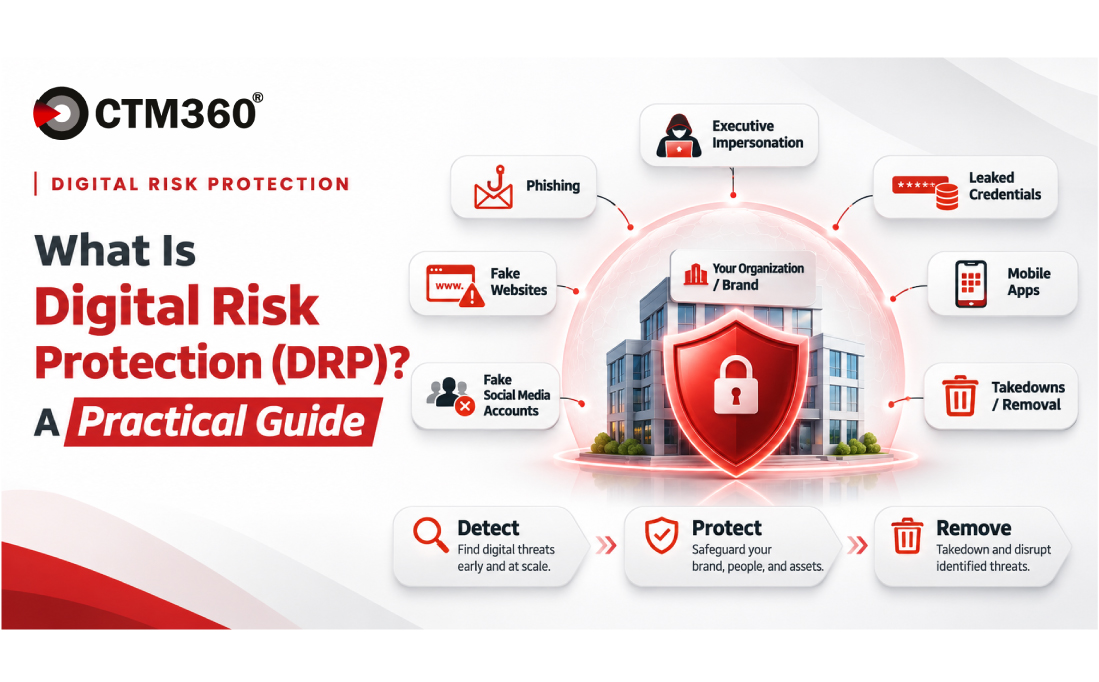
Digital Risk Protection (DRP) addresses this gap. It identifies and supports the removal of external threats targeting an organization’s brand, executives, customers, employees and data. It belongs on the executive agenda because reputational damage and stakeholder losses can begin long before the security team becomes aware of an incident.
Complaints about these campaigns often reach customer service, legal, communications or an executive’s office after the threat has already been active for some time. Fraudsters can also replace a removed website, advertisement or profile quickly, making manual reporting difficult to sustain.
The question for executives is therefore not simply whether a threat was reported. It is how long customers could still reach it, how quickly it was contained and who was accountable for the response.
What Digital Risk Protection Covers Beyond Your Network
Brand protection covers the use of the company's name and identity to deceive people, and social media fraud is the most common form of it. Criminals open fake profiles and impersonate executives. They also run misleading advertisements and make fraudulent offers to exploit customer trust, and customers bear the losses even when the company's own systems stay secure.
Coverage also has to extend beyond the places where victims are contacted. Customers meet websites and social platforms on the surface web, and the deep and dark web holds the preparation and the proceeds in underground forums and carding shops. CTM360's CyberBlindspot monitors all three layers, and its analysts validate findings around the clock before they are raised.
How Leaked Credentials and Data Expose Organizations to Risk
Leaked credentials and data need their own attention because employee credentials and card data turn up in data dumps and malware logs, and internal code appears on underground forums. The source of a leak sets the response to it: a credential taken from a malware log suggests an infected device and exposed sessions, whereas one from an old breach dump raises a password reuse question, and in either case a leaked credential is evidence of exposure, with a separate check needed to see whether it still works. CyberBlindspot reports what it found and where. The identity and endpoint teams do the resets, since they hold the accounts and devices.
How Executive Impersonation Threatens Brands and Customers
Executives need monitoring as well, and CyberBlindspot watches for impersonation of senior figures on social media and on fake news pages or data leakage websites, including image-based impersonation, so a profile cannot avoid detection by changing a name while keeping the photograph.
Why Managed Takedowns Matter
Detection confirms that a threat exists. It does not remove the threat or prevent more people from encountering it.
Takedowns require coordination with platforms, registrars, hosting providers, application stores and other service providers, each with its own policies, evidence requirements and response times. Managing this process case by case places a significant burden on internal security, legal and brand teams.
CTM360 Managed Takedowns automates evidence collection, reporting and follow-up through more than 200 integrations globally. CTM360’s Cyber Incident Response Team (CIRT) oversees the workflow and handles escalation with the relevant providers, reducing the work required from customer teams while preserving visibility into case status.
When full removal is delayed, Global Threat Disruption can help restrict access to a verified threat while the takedown remains in progress. CTM360 reports an average containment response time of six minutes, with coverage across 99% of web browsers.
CTM360 also reports that 98% of phishing sites are removed within 24 hours and 90% of executive impersonation cases within 48 hours. These figures apply to different incident categories and should be assessed separately. Final removal remains dependent on third-party platforms and infrastructure providers, so some cases will take longer.
Continued monitoring is equally important. If a fraudulent website, profile or advertisement returns on new infrastructure, the response process must begin again.
Who Owns Digital Risk Protection?
Security teams commonly own the DRP program, cyber threat intelligence and takedown coordination. However, effective response requires clear responsibilities across several functions:
- Fraud teams provide victim evidence and assess financial impact.
- Communications teams warn customers and employees when necessary.
- Human resources verifies legitimate vacancies and recruitment channels.
- Finance establishes independent approval controls for payment requests.
- Legal and brand teams support enforcement and public statements.
- Identity and endpoint teams respond to exposed credentials and compromised devices.
One function should coordinate each incident so that complaints and evidence are not passed between departments without action.
How Should the Board Measure DRP?
Board reporting should focus on stakeholder exposure and business outcomes, not operational activity alone.
Useful measures include:
- How long confirmed threats remained accessible
- How quickly threats were contained and removed
- The number and type of confirmed incidents
- The recurrence rate of campaigns after removal
- The number of customers, employees or applicants affected
- Escalations that exceeded agreed response targets
The number of takedown requests filed measures effort. It does not show whether customers were protected or how long they remained exposed.
How CTM360 Supports Digital Risk Protection
CyberBlindspot provides brand protection; surface, deep and dark web monitoring; leaked credential and data detection; executive impersonation monitoring; and coverage for threats including phishing, deepfakes, fake advertisements, job scams and money-mule recruitment.
Confirmed threats can be escalated through Managed Takedowns, with automation and CIRT oversight supporting evidence collection, provider engagement, escalation and continued monitoring.
CyberBlindspot operates within CTM360’s consolidated external security platform alongside HackerView and RiskHub. This allows digital-risk findings to be considered in the context of the organization’s external assets, exposures and third-party relationships.
Request a demo to see what CTM360 can identify for your brands, domains and leadership team using publicly available data.
FAQs
1. Our company wasn't hacked, so why are customers reporting fraud under our name?
Criminals do not need access to a company's systems to impersonate it. They can create fake websites, social media profiles and advertisements using publicly available branding. Customers may believe they are dealing with the legitimate business, even though the fraud takes place entirely outside its network. These incidents fall within Digital Risk Protection (DRP) and should be investigated separately from internal security breaches.
2. Someone has created a fake website using our company name. What should we do first?
Preserve the website address, screenshots, fraudulent messages and any customer complaints. Confirm that the website is unauthorised, then report it to the relevant hosting provider or domain registrar. If customers are already being targeted, publish a warning through official communication channels while the removal request is processed.
3. We've reported a fake social media account several times. Why is it still online?
Social media platforms review impersonation reports according to their own policies, and removal is not always immediate. Reports may require additional evidence of identity, trademark ownership or fraudulent activity. Organisations should preserve evidence, use the platform's appropriate impersonation or intellectual property reporting process, and continue monitoring for replacement accounts.
4. Scammers are advertising fake jobs using our company name. Should HR or cybersecurity handle this?
Both teams have a role. HR should confirm which vacancies and recruitment channels are legitimate and warn applicants about fraudulent offers. Cybersecurity can investigate impersonating domains, accounts and messages, while legal or brand teams may support removal requests. Having one team coordinate the incident prevents complaints from being passed between departments.