Digital Risk Protection Between the Security and Brand Teams

What’s on this page
When a digital risk program fails, it usually breaks down at the handoff. Security might flag a fake storefront immediately, but the takedown stalls because legal wants to review the paperwork and the brand team is busy fielding customer complaints. While internal teams spend days figuring out who actually owns the response, the site stays live. The delay isn't caused by a lack of threat visibility it’s organizational friction. Fraud doesn’t neatly fit into one department, and the scammers, meanwhile, are not waiting for an approval email. A digital risk program only actually works when the question of who validates, authorizes, and acts is settled long before the alert arrives.
Which team feels which use case
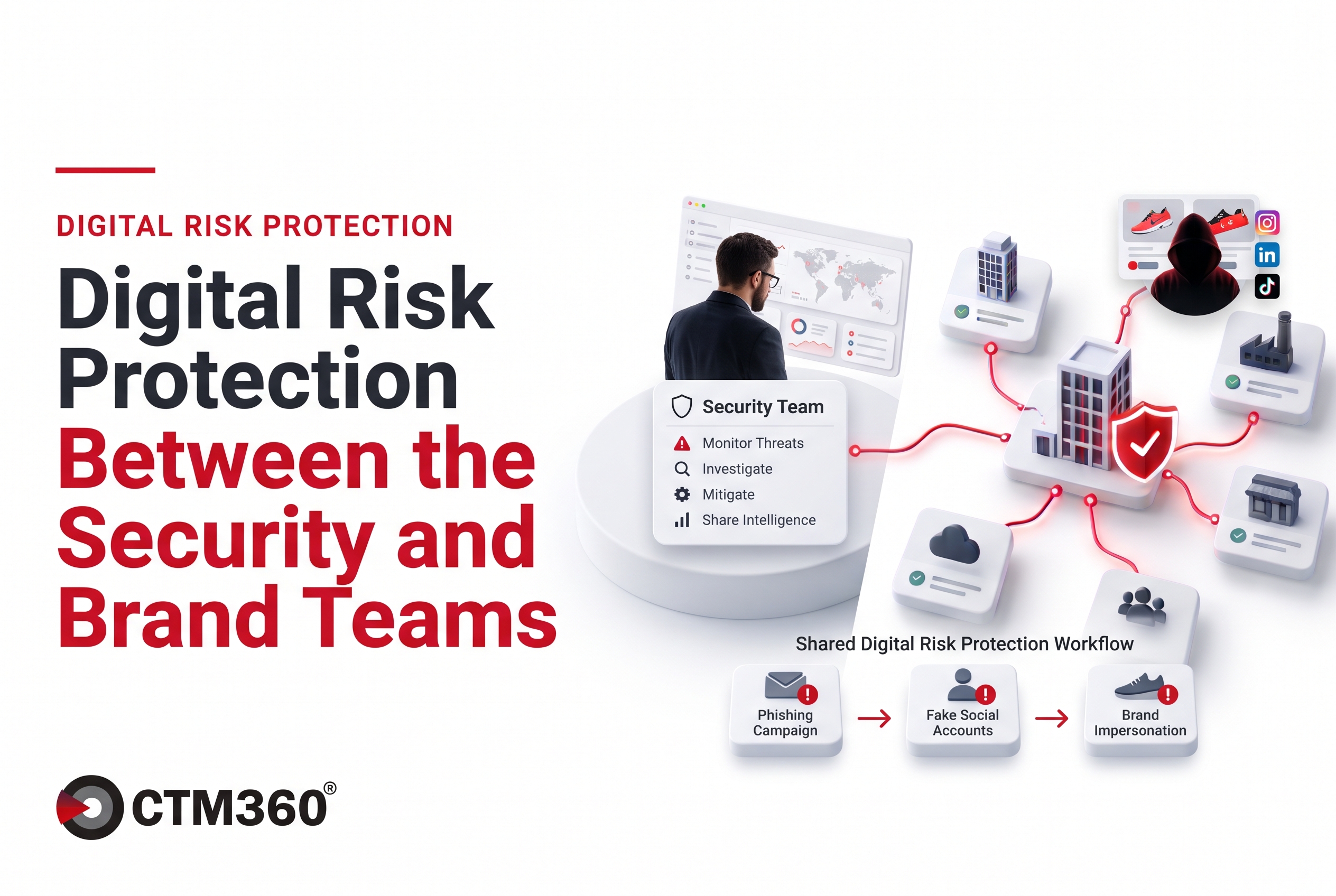
Digital threats affect different departments, and each presents its own challenges. Phishing kits can evade security scanners, while fake social profiles, rogue mobile apps, and brand impersonation often surface through customer complaints. Executive impersonation, including AI-generated videos, involves communications teams, while business email compromise frequently reaches finance through fraudulent payment requests.
Data leakage requires further investigation, as credentials found in malware logs may indicate active compromise, whereas older breaches often suggest password reuse. Meanwhile, fake advertisements, job scams, money mule recruitment, fabricated news stories, and dark web exposure create risks that extend across security, HR, brand, and customer service teams.
The challenge is that these threats rarely fall under one department's responsibility, making coordinated detection and response essential.
Why Early Detection Matters in Digital Risk Protection
Security analysts struggle with volume and noise when a scan returns hundreds of unverified matches that cost hours and turn out to be a fan page or a coincidental name, and after a few rounds the team stops trusting the feed. Brand teams meet the opposite problem: they see the harm directly but cannot tell which accounts and domains legitimately belong to the company, so a suspicious item can wait in an email thread while someone checks.
Timing adds a further difficulty, because detection that waits for a live page finds the fraud after the first victims have been reached. Earlier signals exist. Lookalike domains and certificates issued in the company's name usually appear before a campaign goes live, so a workable program treats a new registration as a case to track and not as an incident to close.
What goes wrong in takedowns
Every provider that hosts or registers content has its own reporting channel and required format and responds at its own speed, which a team filing by hand learns slowly and at the victims' expense. Removal is also only half of the work, since operators rebuild: a site removed on Tuesday can reappear on a new domain by Wednesday, and a request that closed successfully has accomplished little.
The handoff problem returns at this stage: brand and legal teams get asked for evidence or authorization letters at the moment the fraud is spreading and security cannot proceed until they answer. Customers lose money in that gap. Reporting makes it harder to see, because a monthly count of sites taken down says nothing about how long each stayed live or whether anyone was harmed, and those are the questions executives put to brand teams when they want the cost of delay in business terms.
How the CTM360 platform closes the loop
Eliminating these departmental bottlenecks requires putting detection and removal on the same platform, which is exactly how CTM360 closes the loop. CyberBlindspot watches open sources as well as closed and underground ones, and it reports phishing and impersonation alongside leaked credentials and the lookalike domains behind business email compromise. Pages are examined for their forms and logos in addition to keywords, and reverse image search catches reused executive photographs. CTM360 analysts also interact anonymously with fraudsters to gather attack data that passive monitoring misses. FraudNavigator, a fraud framework within CyberBlindspot, follows a scam from preparation to payment, so a team can work on the whole campaign in place of a single page. CTM360 reports no false positives for evidence-backed DRP findings, so a brand team has a reason to trust what reaches the queue.
Removal runs through Managed Takedowns, which are automated across more than 200 integrations and which the CIRT oversees and manages in every aspect of each case, so the customer's security and brand teams file nothing and assemble no evidence. CTM360 reports 98% of phishing sites down within 24 hours and 90% of executive impersonations within 48 hours. Hosts and platforms set their own pace, so some cases take longer. Global Threat Disruption covers the open-request period with a six-minute mean disruption time across all major web browsers. The service is pre-populated and managed by CTM360 from the first day, so neither team begins with an empty configuration.
Why Digital Risk Protection Requires Teams Collaboration
In CTM360's Opinion, security teams normally own DRP, CTI and takedowns; IT owns EASM and exposure management; GRC owns TPRM. Within DRP, security runs the program and the brand and legal teams receive confirmed cases and decide on enforcement and public statements, which works best when security keeps a current register of the company's legitimate domains and profiles and agrees it with brand and legal, since that register is the quickest way to stop a genuine asset from being flagged. Leaked credentials go to the identity team for resets, because the accounts and devices are theirs, and confirmed lookalike domains go to finance and procurement so that staff and suppliers are warned before a payment request arrives.
CTM360 serves more than 1,000 institutions in approximately 100 countries, and DRP is one module on the same platform as external attack surface and exposure management.
Request a demo: DRP findings and external attack surface data are already on the platform from public sources, so security and brand teams start from the same record.
1. What is Digital Risk Protection and why do organizations need it?
Digital Risk Protection (DRP) helps organizations identify, monitor and respond to external digital threats targeting their brands, customers and executives. It covers phishing websites, brand impersonation, fake social media accounts, rogue mobile applications, leaked credentials and other forms of online fraud that traditional internal security controls may not detect.
2. Who should be responsible for Digital Risk Protection in an organization?
Cybersecurity teams typically manage Digital Risk Protection programs, including threat detection, investigation and response. Brand and legal teams support the validation of impersonation cases, enforcement decisions and public communications. Finance, fraud and customer service teams may also be involved depending on the nature of the threat.
3. Can Digital Risk Protection detect phishing and impersonation before an attack begins?
Digital Risk Protection can identify early warning signs, including newly registered lookalike domains, suspicious certificates and accounts impersonating an organization or its executives. These indicators may appear before a phishing website or fraudulent campaign becomes active, allowing security teams to investigate and monitor potential threats earlier.
4. Why do organizations struggle with false positives in brand impersonation detection?
False positives occur when legitimate websites, fan accounts or unrelated domains are incorrectly identified as impersonation threats. High alert volumes increase investigation time and reduce confidence in monitoring results. Maintaining an accurate inventory of authorized digital assets and validating suspicious findings against supporting evidence can improve detection quality.
5. Is domain impersonation still a security incident if nobody has been hacked?
Absolutely. Even if your internal network is perfectly secure, an attacker can still use a lookalike domain to trick a customer or vendor into redirecting a payment. It requires an immediate response, regardless of whether a traditional 'hack' took place.