Next-Gen Cyber Threat Intelligence Beyond IoCs: IoE, IoW, and IoA
Despite decades of investment in cybersecurity, global cyber losses continue to grow exponentially year on year. The industry is investing in additional layers of internal security, yet the scale of the problem continues to grow. AI and digital transformation are additional factors contributing to cybersecurity challenges.
The answer is not to continue adding more layers of internal security technology. It is to adopt a fundamentally different approach. Organizations need to move beyond the reactive model of IoCs to a Preemptive Model of Indicators of Exposure (IoEs), Indicators of Warning (IoWs), and Indicators of Attack(IoAs).
“IoCs are about someone else, somewhere else. IoEs, IoWs and IoAs are about
YOU and NOW.”
- Mirza Asrar Baig, CEO and Founder of CTM360
Today, organizations still manage and secure most of their technology inside the firewall. However, digital transformation and AI are steadily expanding the enterprise beyond its traditional perimeter, with more technology infrastructure becoming internet-facing or operating across cloud platforms, SaaS applications, digital channels, and third-party environments. Currently, approximately 90% of security investment is focused on internal environments, while only 10% is directed toward external environments.
Based on the evolving digital landscape, CTM360 proposes that by 2030, this balance could shift, with more than 40% of security investments directed toward technologies outside the traditional perimeter and less than 60% remaining focused on internal environments.
This external infrastructure needs the same level of visibility and discipline as internal IT Infrastructure. Security teams therefore need to maintain a separate, continuously managed Digital Asset Register for their external digital environment. This will also transform the concept of CTI, making it much broader than traditional IoC feeds.
Indicators of Exposure (IoEs), Warning (IoWs), and Attack (IoAs)
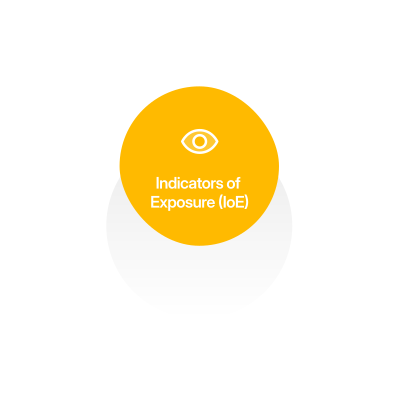
Next-generation Cyber Threat Intelligence includes more than just IoCs. It integrates Indicators of Exposure (IoEs), Indicators of Warning (IoWs), and Indicators of Attack (IoAs).
CTM360 embeds AI workflows across the intelligence lifecycle to process large-scale threat and exposure data. This helps reduce noise and deliver actionable insights for faster response. By combining organization-specific indicators with a TTP-driven approach, CTM360 makes threat intelligence more relevant, contextual, and aligned with preemptive security.
Consolidated Stack of Next-Gen CTI
CTM360 consolidates External Attack Surface Management, Digital Risk Protection, Threat Intelligence, Third-Party Risk, Fraud Intelligence, Email Security, and Managed Takedowns into one centralized Cyber Threat Intelligence Model.
The result is a comprehensive view of an organization’s external assets, exposures, third parties, fraudulent infrastructure targeting the organization, and active attacks.
As organizations expand their digital operations, their assets and exposures increasingly extend across the internet, creating a larger and more complex external attack surface.
Cloud infrastructure, internet-facing systems, subsidiaries, social media accounts, and other digital channels create a constantly evolving external attack surface.
This makes EASM and exposure management an indispensable part of today's threat intelligence.
If these exposures and weaknesses are not addressed in time, attackers can exploit them to launch an attack.
Through HackerView Platform, CTM360 discovers and validates the organization’s genuine digital assets. This extends beyond technical data points such as domains, hosts, IP addresses, services, and SSL certificates to include business context such as subsidiaries, executives, social media accounts, and BIN numbers.
By combining technical infrastructure with business context, CTM360 builds a more accurate and comprehensive representation of the organization’s digital presence.
Once the attack surface is mapped, CTM360 identifies vulnerabilities, misconfigurations, exposed services, and other security issues affecting those assets.
These findings provide an outside-in assessment of security posture and allow organizations to understand indicators of exposure, where weaknesses are concentrated, how posture is changing, and which areas require attention.
The next step is determining which exposures and vulnerabilities are actually affecting your organization. Through the DeepScan module, CTM360 performs technology-specific, non-intrusive scans to validate vulnerabilities, detect misconfigurations, and identify other security issues.
Findings can be prioritized based on factors such as severity and likelihood of exploitation. This helps security teams focus remediation efforts on the weaknesses most likely to impact the organization.
This moves IoE beyond simply identifying weaknesses.
It helps answer three increasingly important questions: What do we own? What is exposed? What should we fix first?
Within CTM360’s consolidated Cyber Threat Intelligence Stack, Indicators of Warning are early signs that attack infrastructure is being prepared for use.
These warning signs may include:
- Typosquatted or lookalike domains
- Third-party risks
- Recurring attacker techniques (TTPs)
- Unauthorized activity involving the organization’s email domains
This also includes the early identification of leaked data that has not yet been used to carry out an attack.
A lookalike or typosquatted domain can signal malicious intent even before any fraudulent content appears. CTM360 monitors these domains from the moment they are registered and flags them as warning indicators. This allows security teams to monitor potential abuse and take action when malicious activity is detected.
Any issue within your third-party environment that could potentially provide attackers with a pathway into your organization becomes an early warning indicator.
CTM360 extends monitoring into the third-party ecosystem, allowing security teams to continuously assess the external security posture of organizations of interest. CTM360’s TPRM platform, RiskHub, combines external monitoring with vendor assessments and compliance workflows, enabling organizations to evaluate both observable cyber risks and adherence to required security controls.
All data is pre-populated and available from day one, requiring no access to internal systems or input from end users or their third parties.
CTM360 analyzes recurring adversary tactics, techniques, and procedures to provide risk-based hardening recommendations. Mapped to the MITRE ATT&CK framework, these recommendations help security teams strengthen controls against techniques most relevant to their environment and disrupt potential attack paths before they are used.
CTM360 also provides a Kill Switch recommendation, identifying the critical technique or control point that can break the attack chain. Rather than trying to disrupt every technique used in a campaign, security teams can focus on the point that can stop the campaign from progressing.
DMARC monitoring further supports this layer of intelligence by identifying unauthorized email senders, spoofing attempts, and weaknesses across SPF, DKIM, and DMARC configurations.
Together, these capabilities help organizations recognize warning signals early and take preventive action before they escalate.
Indicators of Attack (IoAs) indicate that malicious activity has progressed further and is now actively targeting the organization, its customers, employees, executives, brands, data, or digital assets.
CTM360's DRP platform, CyberBlindspot continuously identifies active fraud and scam campaigns across the surface, deep, and dark web. These may include phishing websites, brand and executive impersonation, data leaks (used for ransomware extortion), malicious domain intelligence, and more.
Traditional CTI primarily focuses on Indicators of Compromise (IoCs), such as malicious domains, IP addresses, file hashes, URLs, and other threat artifacts. CTM360 provides IoCs by aggregating indicators from multiple external and threat intelligence sources.
CTM360's Next-Gen CTI provides broad threat intelligence with contextual analysis, including global threat actor claims, CERT announcements, vulnerability intelligence, visibility into emerging cyber threats, and the extraction of IoCs to augment security operations.


.svg)
.svg)
.svg)


.svg)
.svg)


.svg)

.svg)
.svg)


.svg)


.svg)